

Conductive 3D Printing: Ink vs Filament
Conductive 3D printing enables electrical functionality to be built directly into manufactured components. This article compares conductive ink systems and conductive filament approaches.
Conductive materials are what make conductive 3D printing possible. Instead of fabricating circuits separately and mounting them onto structures later, conductive printing technologies allow electrical features to be produced directly during the manufacturing process.
This capability sits within the broader category of 3D printed electronics, where circuits, antennas, and sensors are integrated into the physical structure of a component rather than assembled afterward.
Conductive Ink Printing
Many additive electronics systems rely on conductive inks that contain metallic nanoparticles, most commonly silver. These inks are deposited onto substrates using inkjet or aerosol printing systems to create electrical traces.
After printing, the traces typically require additional processing steps such as curing or sintering to achieve usable electrical conductivity. These extra steps can introduce workflow complexity and require tightly controlled processing conditions.
Ink-based approaches are often used when extremely fine traces are required or when working with specialized additive electronics machines designed for high-resolution deposition.
Conductive Filament Printing
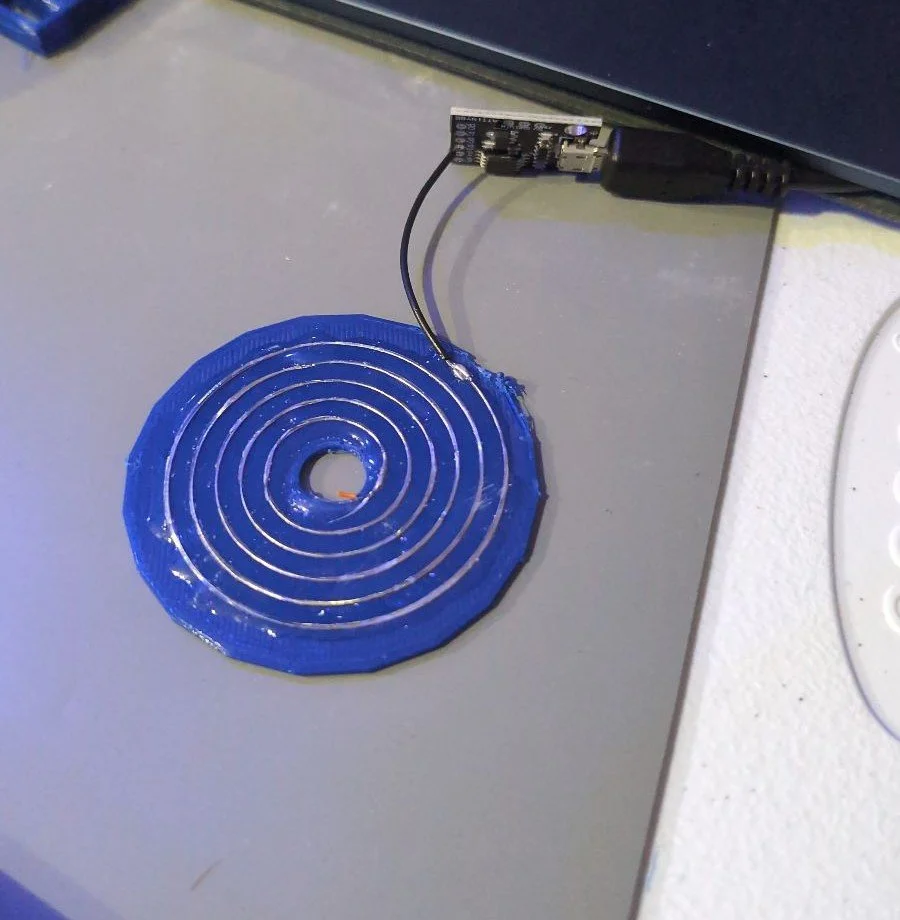
An alternative approach uses conductive filament in FDM or FFF 3D printers. Instead of depositing conductive material onto a surface, conductive filament is extruded through the printer nozzle and integrated directly into the printed part.
This method allows electrical pathways to be printed alongside structural materials within the same component. Conductive filament workflows enable electrical and mechanical features to be manufactured simultaneously.
Examples of what conductive filament printing can enable include:
Embedded signal routing
Integrated sensors
Conformal conductive paths
Embedded antennas
Multi-material printed electronics
Embedded 3D Printed Electronics
One of the most significant advantages of filament-based systems is the ability to create embedded 3D printed electronics. Instead of mounting electronics after a component is manufactured, conductive features can be printed directly into the structure itself.
This approach enables engineers to design mechanical and electrical systems together instead of treating them as separate assemblies.
Embedded conductive pathways can reduce wiring harnesses, simplify assembly, and allow electrical routing to follow complex geometries that would be difficult to achieve with traditional planar circuit boards.
Comparing Ink and Filament Approaches
Both conductive inks and conductive filament systems play important roles in additive electronics. However, they are optimized for different engineering goals.
Ink-based systems often prioritize resolution and precision, making them useful for micro-scale traces and research applications.
Filament-based systems emphasize integration and structural embedding, allowing electrical functionality to be incorporated directly into printed parts.
For many applications involving embedded electronics, the ability to integrate conductors directly into structural components can simplify system architecture and accelerate development.
Where Conductive 3D Printing Fits
Conductive additive manufacturing expands the design space available to engineers. Instead of relying exclusively on planar boards, electrical features can be integrated directly into mechanical components.
This approach is particularly valuable when geometry, integration, or rapid iteration are key drivers in system design.
Organizations evaluating conductive additive manufacturing often begin by building a small subsystem prototype to determine where embedded electrical features provide practical advantages.
What Is Additive Manufactured Electronics (AME)?
Additive Manufactured Electronics (AME) uses additive processes to create circuits on or within structures. This article explains how AME works, its limits, and where embedded 3D printed electronics fits.
Additive Manufactured Electronics (AME) is the process of building electronic circuits using additive manufacturing methods instead of traditional subtractive PCB fabrication. In practical terms, AME is part of the broader category of 3D printed electronics, where conductive features are printed onto or into a substrate rather than etched from copper-clad boards.
How AME Works
Most AME workflows use one of three approaches:
Ink-based deposition of conductive materials
Hybrid systems that print dielectric and conductive layers
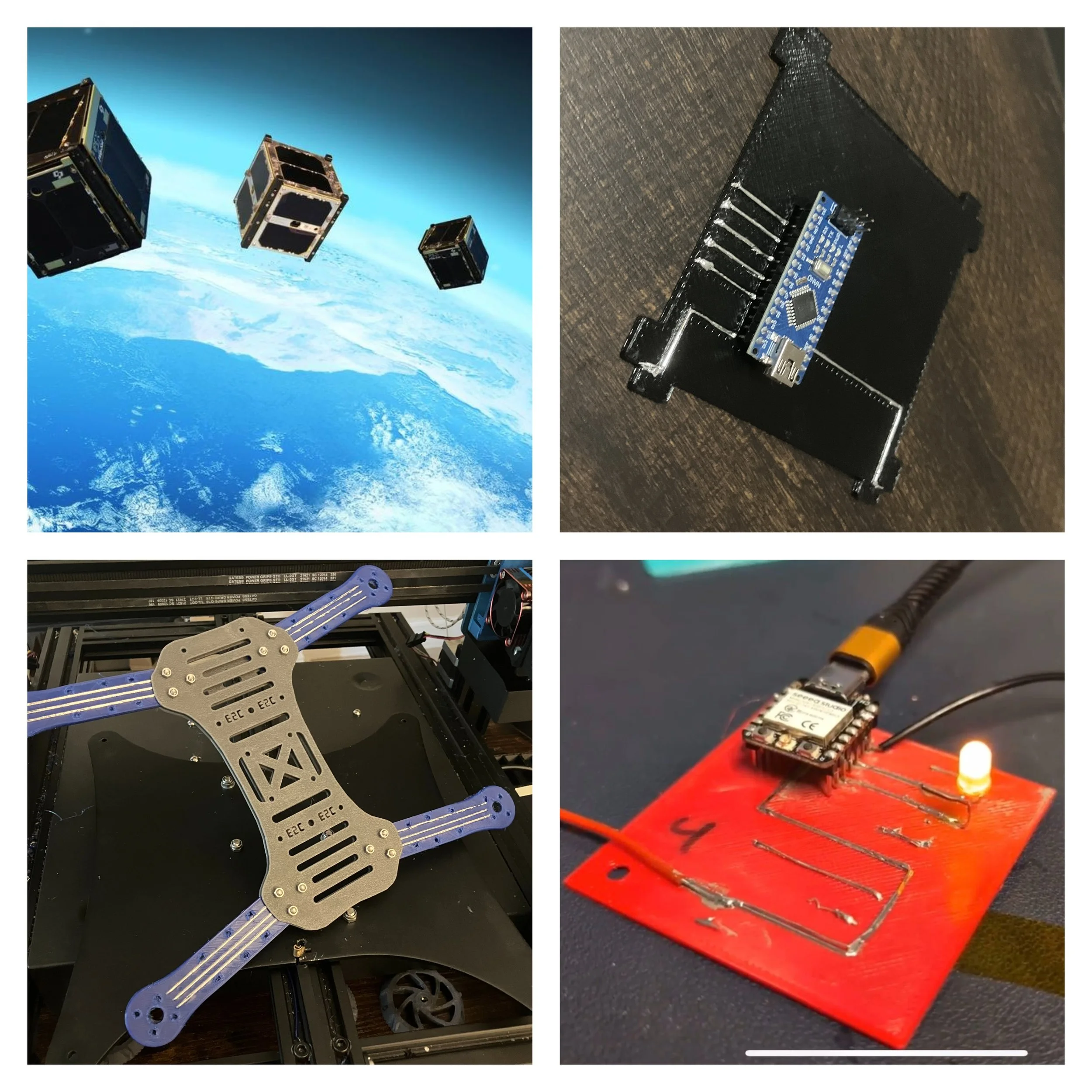
FDM-based approaches using conductive filament
Ink-based approaches often print metallic nanoparticle inks and then require curing or sintering to reach useful conductivity. Hybrid systems build multi-layer stacks through multiple print and deposition steps. FDM-based approaches use conductive filament to print conductive paths directly as part of the build.
What AME Solves
AME is useful when you need rapid iteration without committing to tooling or minimum order quantities. It can also enable embedded electronics integration when the goal is to place conductive paths, sensors, or RF features directly into the structure instead of mounting electronics afterward.
Where AME Is Limited
AME is not a universal replacement for traditional PCBs. Many AME systems require specialized equipment and controlled processes, and some approaches are constrained by post-processing steps, substrate compatibility, and current-carrying capability.
Traditional PCB fabrication remains the best tool when you need high-density, high-speed planar routing at volume. AME becomes compelling when geometry, iteration speed, and integration outweigh the advantages of a conventional board.
Embedded AME Using Conductive Filament
One branch of AME focuses on embedded conductors using conductive filament in FDM systems. Instead of printing traces on a flat board, conductive features can be printed into the part itself.
This can enable:
Embedded signal routing
Integrated sensors
Conformal conductive paths
Embedded antennas and RF structures
AME and Embedded 3D Printed Electronics for Aerospace and Defense
Aerospace and defense systems often benefit from embedded 3D printed electronics because geometry, weight, assembly complexity, and iteration speed are operational constraints, not edge cases.
When electronics can be embedded into structure, teams can reduce interconnects, simplify routing, and prototype faster without waiting on external fabrication cycles for every iteration.
Where AME Fits in Modern Manufacturing
AME expands the design space. It does not erase PCBs.
The practical model is hybrid:
Use PCBs when planar density and production scale dominate
Use AME when integration, geometry, and iteration speed dominate
If you want to evaluate AME without overcommitting, the fastest path is to start with a subsystem evaluation where wiring, geometry, or iteration speed is already causing pain.